Connoisseur's Compass: Separating Genuine Arabian Confectionery from Its Commercial Counterfeits
There is a particular kind of disappointment reserved for the moment a beautiful box is opened, a gilded bonbon is lifted to the lips, and the experience delivers nothing beyond sugar and artifice. As Dubai-inspired luxury confections have ascended in the American market — appearing in boutique retailers from SoHo to Beverly Hills, in curated subscription boxes, and across the feeds of food-focused tastemakers — so too has a shadow industry of convincing impostors. The gold leaf is real enough. The packaging is impeccable. But the soul, as any practiced palate will confirm within seconds, is entirely absent.
Learning to read the difference is not merely a matter of snobbery. It is the difference between spending thoughtfully and spending blindly — between honoring a centuries-old confectionery tradition and inadvertently funding its dilution.
The Ingredient Provenance Question
Authentic Dubai-inspired confectionery begins long before the kitchen. It begins in the sourcing. The finest Arabian confections rely on ingredients whose origins are as significant as their quality — and those two things are, in the world of genuine luxury, inseparable.
Saffron, for instance, should be traceable to either Iranian or Kashmiri cultivation, where the spice's characteristic floral bitterness and deep crimson hue develop under conditions impossible to replicate commercially at scale. When a confectioner lists simply "saffron" without provenance, or when the finished product carries only the faintest suggestion of the spice's complexity, the ingredient in question is almost certainly a low-grade substitute or an extract engineered for color rather than flavor.
Similarly, rose water — one of the most defining aromatic signatures of Arabian confectionery — demands careful scrutiny. Genuine rose water, distilled from Damask roses in Bulgaria or the Taif region of Saudi Arabia, carries a softness that is simultaneously floral and slightly green, never perfumed in the synthetic sense. Commercial operations frequently substitute rose flavoring compounds that announce themselves with an almost chemical brightness. The difference is immediate and unambiguous to anyone who has encountered the real thing.
Medjool dates, cardamom, and orange blossom water follow the same logic. Ask where they come from. If a producer cannot or will not answer, that silence is its own form of disclosure.
Artisanal Production: The Marks Left by Human Hands
Beyond ingredients, the method of production leaves evidence that a careful observer can identify without ever stepping into a kitchen.
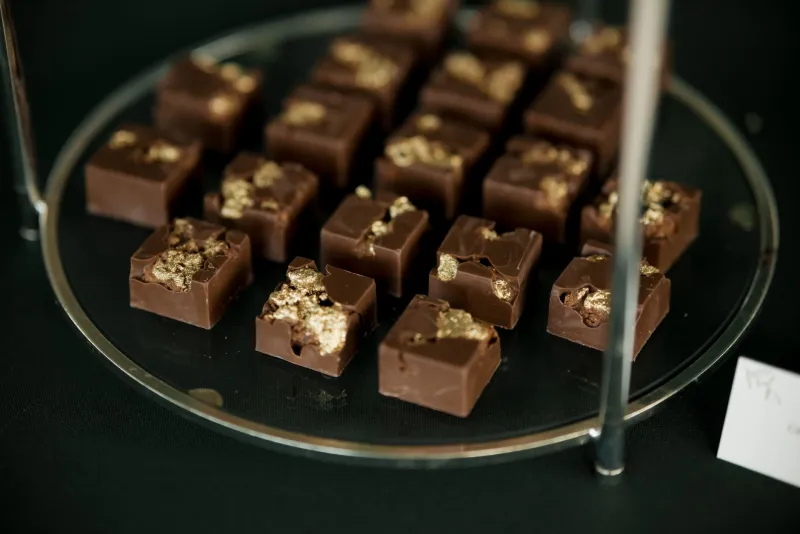
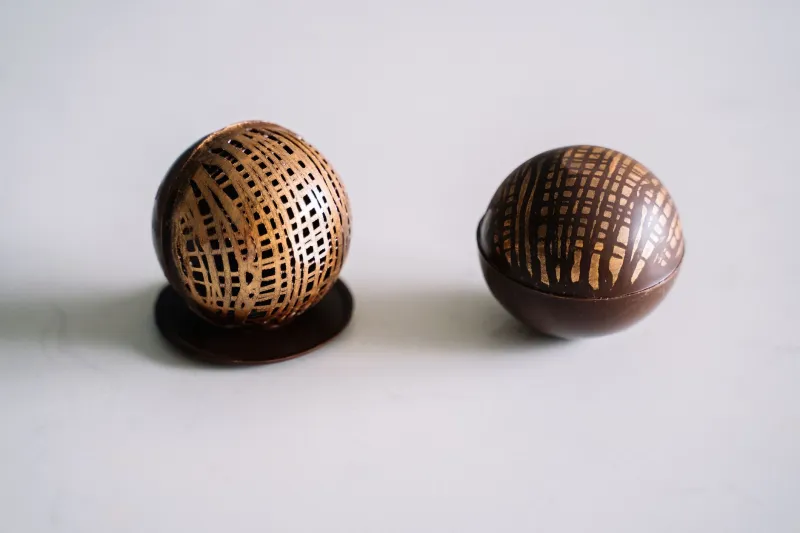
Genuine artisanal confectionery is, by its nature, imperfect in the most beautiful sense of the word. Hand-tempered chocolate carries a sheen that is luminous rather than uniform — slight variations in surface texture are not flaws but fingerprints, evidence of a craftsperson's direct engagement with the material. Mass-produced chocolates, by contrast, achieve a kind of mechanical perfection: identical dimensions, identical gloss, identical weight. They are impressive in the way that a printed photograph of a painting is impressive — technically accomplished, experientially hollow.
Look closely at truffles, bonbons, and molded confections. The seams where molds close should be nearly invisible on high-quality pieces, finished by hand rather than left as a manufacturing artifact. The weight of a single piece should feel substantial relative to its size — a reflection of dense, quality-forward ganaches and fillings rather than aerated compounds padded with stabilizers.
Arabian-inspired sweets such as basbousa, luqaimat, and ma'amoul carry additional visual cues. Authentic versions exhibit the natural variation of hand-formed or small-batch production: a slight irregularity in the semolina crust of a well-made basbousa, the gentle asymmetry of hand-pressed ma'amoul molds. Commercial versions are aggressively uniform in a way that should, paradoxically, raise suspicion rather than inspire confidence.
Reading the Flavor Architecture
Perhaps the most reliable authentication tool available to any consumer is the palate itself — specifically, an understanding of how genuine Arabian confectionery is structured in time.
Authentic Dubai-inspired confections are built around what might be described as a layered aromatic progression. The initial impression is rarely the most important one. A well-crafted cardamom chocolate, for example, should open with the warm, citrus-edged brightness of the spice before yielding to the deeper, almost eucalyptus-like notes that develop as the chocolate melts. The finish should carry a gentle, lingering warmth — not heat, but resonance. When cardamom is used merely as a flavoring agent rather than a considered ingredient, the progression collapses into a single, flat impression that fades quickly.
The same principle applies to oud-inflected preparations, saffron custards, and pistachio-based confections. Elite confectioners understand that Arabian flavor profiles are not simply about intensity — they are about the relationship between arrival, development, and departure. A confection that delivers everything in its first second and offers nothing thereafter is, almost without exception, a commercial product wearing artisanal clothing.
Sweetness level is also instructive. Authentic Arabian confectionery traditions favor sweetness that is present but balanced by the aromatic complexity of spices, the slight astringency of rose or orange blossom water, and the natural bitterness of high-quality chocolate or nut pastes. Products that lead with overwhelming sweetness and little else are calibrated for mass appeal, not for the discerning palate.
What Transparency Looks Like
Legitimate luxury confectioners are, almost universally, eager to discuss their craft. They name their chocolate couverture suppliers. They identify the farms or cooperatives from which they source dates and pistachios. They describe their production schedules and explain why batches are limited. This transparency is not marketing theater — it is the natural behavior of producers who are genuinely proud of decisions that cost them considerably more than the alternatives.
When a brand's website or packaging offers only vague gestures toward quality — phrases like "inspired by the finest traditions" or "crafted with premium ingredients" without any specificity — treat that ambiguity as a signal. Authenticity, in the luxury confectionery world, is almost always accompanied by detail.
Certifications matter, though they are not sufficient on their own. Halal certification from a recognized body is standard among reputable Arabian confectioners. Direct relationships with ingredient suppliers, documented on the producer's website or available upon inquiry, are a stronger marker still.
Investing in the Genuine Article
The American luxury dessert market is, at its best, a space where consumers exercise genuine discernment — where the decision to spend more is grounded in knowledge rather than packaging alone. Dubai's confectionery tradition is one of the world's most sophisticated, and it deserves to be encountered in its authentic form.
The impostors are not difficult to identify once one knows what to look for. Vague sourcing, mechanical uniformity, flavor profiles that exhaust themselves in a single note, and evasiveness about production methods are the consistent hallmarks of mass-market confections dressed in luxury's vocabulary. The genuine article, by contrast, rewards attention — in the kitchen, on the label, and above all, in the experience of the thing itself.
Discover the difference once, and the commercial imitation loses its ability to deceive entirely.