Choreographed Indulgence: How Dubai's Pastry Chefs Are Turning Dessert Service Into a Living Art Form
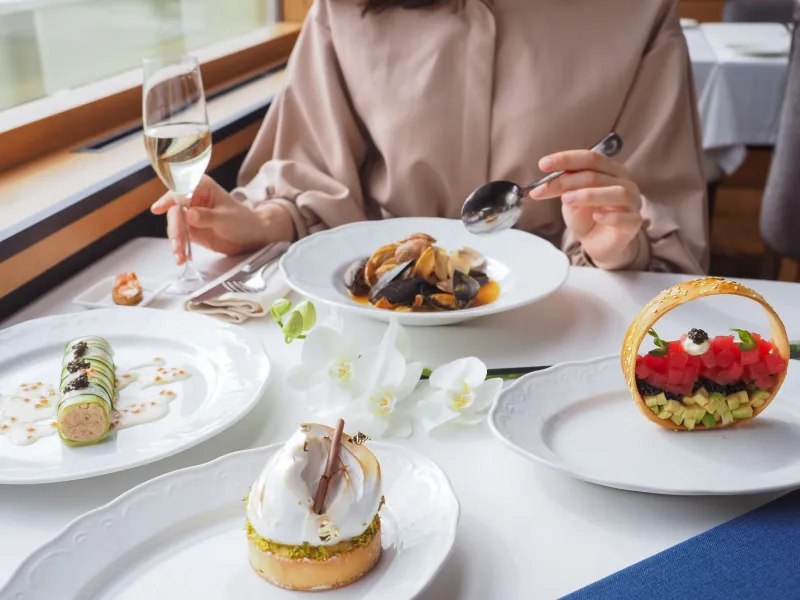
There is a particular moment—known among Dubai's elite confectionery circles as the breath—that occurs in the finest dessert experiences the city has to offer. It happens after the previous course has been cleared, before anything new arrives. The table is empty. The room holds its silence. And then, with calibrated precision, the performance begins.
This is not accident. It is architecture.
Dubai's most celebrated pastry chefs have, over the past several years, quietly reimagined what it means to serve a dessert. Where once the focus rested almost entirely on what arrived on the plate, the conversation has shifted to encompass everything surrounding that moment: the timing of the approach, the sequence in which elements are presented, the temperature of the room, the specific quality of light. In these establishments, dessert is no longer a conclusion. It is a composition.
The Philosophy of the Purposeful Pause
To understand why Dubai has emerged as the unlikely capital of dessert performance art, one must first appreciate the cultural context from which it springs. The Emirati tradition of hospitality—diyafa—has always treated the offering of food as a deeply ceremonial act. Coffee is not simply poured; it is presented. Dates are not merely set on a table; they are arranged with an awareness of what their placement communicates to the guest.
Contemporary pastry chefs in Dubai have inherited this sensibility and translated it into a thoroughly modern idiom. The result is a dessert service philosophy built on what might be called intentional friction: the strategic deployment of slowness, silence, and restraint to heighten anticipation and deepen the eventual experience of flavor.
"We think of each dessert as having a tempo," explains one Dubai-based pastry director whose work has drawn international attention. "Some flavors demand to be met with stillness. Others need movement, sound, a shift in the environment. Our job is to understand what each creation requires and then design the entire moment around that need."
The implications of this approach extend well beyond aesthetics. Neuroscientific research increasingly supports the idea that the conditions under which food is consumed materially affect how it tastes. Pacing, anticipation, and environmental cueing all modulate the brain's response to flavor—a fact that Dubai's most ambitious confectioners have understood intuitively for years and are now applying with something approaching scientific rigor.
Sequence as Storytelling
In practice, this philosophy manifests in ways that can surprise first-time visitors accustomed to more conventional dessert service. At several of Dubai's premier confectionery studios, the dessert experience unfolds in distinct acts, each separated by a deliberate interval that functions less as a waiting period and more as a form of editorial punctuation.
A guest might first receive a single, impossibly delicate petit four—not as a preview, but as a threshold, a moment designed to recalibrate the palate and shift the diner's psychological register from the savory world they have just left. Minutes later, a second element arrives: perhaps a small vessel of warm, spiced liquid meant to be inhaled before it is consumed. Only then does the principal dessert make its appearance, and by that point, the guest has been so carefully prepared that the experience of eating it carries a weight entirely disproportionate to its physical scale.
"The sequence is the message," says one pastry chef who trained in both Paris and Abu Dhabi before establishing her own studio in Dubai's Design District. "By the time the main dessert arrives, the guest understands—on a level they may not be able to articulate—that something important is happening. That understanding changes everything about how they receive it."
The plating itself operates within this same logic. Elements are not arranged for visual impact alone; their placement on the plate is calculated to guide the eye and, consequently, the fork. The guest is being led through a prescribed experience without ever being told what to do—a form of hospitality so refined it renders itself invisible.
What American Fine Dining Is Beginning to Learn
For years, the theatrical dimension of Dubai's dessert culture registered in the United States primarily as spectacle: the gold leaf, the dramatic smoke, the tableside flourishes that translated easily into social media content. What is now beginning to cross the Atlantic—or, more precisely, to cross both oceans—is something considerably more subtle and, arguably, more transformative.
A growing number of American pastry chefs and fine dining restaurateurs have spent time in Dubai's kitchens, and what they have brought home is not a set of techniques so much as a set of questions. What does this dessert need from its environment? What should the guest feel in the thirty seconds before they take their first bite? How does the pace of service communicate the value of what is being offered?
In cities including New York, Los Angeles, and Chicago, these questions are beginning to reshape the dessert course at a handful of high-end establishments. The changes are rarely announced; they are simply felt. A slightly longer pause between courses. A server who places the dessert with unusual deliberateness and then withdraws without comment. A small, preparatory element—a flavored water, a single crystallized herb—that arrives before the main event and seems, somehow, to make it taste better.
"American diners are extraordinarily receptive to this," observes one New York-based hospitality consultant who has worked extensively with Dubai's luxury food sector. "They may not identify what is different, but they feel it. They leave those meals talking about them for weeks. That is not an accident."
The Luxury of Being Guided
At its deepest level, what Dubai's performance-oriented dessert philosophy offers is something that has become genuinely rare in contemporary American life: the experience of being cared for with absolute attentiveness. In a culture defined by speed, optionality, and self-direction, the act of surrendering to a carefully designed sensory journey carries its own form of luxury—one that cannot be replicated by price point alone.
The finest Dubai confectioners understand that their guests are not simply purchasing a dessert. They are purchasing a particular quality of attention, a guarantee that someone has thought deeply about every element of their experience and arranged it with their pleasure as the sole objective.
This is, ultimately, what separates performance from theater. Theater asks you to watch. Performance, at its most refined, asks you to be transformed.
Dubai's great pastry chefs have always known the difference. The rest of the world is only now beginning to understand what they have been building—one perfectly timed silence at a time.